


National Institute of Allergy and Infectious Diseases Proposes Reorganization Plan

Updated: Sep 16
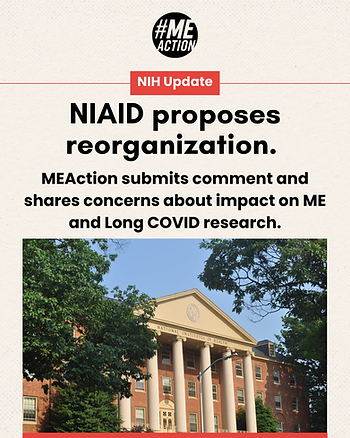
The National Institute of Allergy and Infectious Diseases (NIAID), has released a proposal to eliminate its Division of Clinical Research (DCR) and move the division’s programs and responsibilities into other parts of the Institute.
DCR brings together many of the services needed to conduct safe, effective clinical research. These include clinical research operations, statistics, regulatory oversight, domestic and international partnerships, and the ability to respond quickly to emerging research needs.
Under the proposal, these connected responsibilities would be divided among the NIAID Office of the Director, Division of Intramural Research, and Division of Microbiology and Infectious Diseases. This could create more complicated chains of command, slow approvals and contracting, make responsibility for decisions less clear, and lead to the loss of specialized staff and institutional knowledge.
NIAID also proposes placing the Clinical Director and a new Office of Biostatistics Research within the Office of the Director. This could give these functions greater reach across the Institute. It could also concentrate authority over which studies move forward, how trials are designed and evaluated, how safety and regulatory questions are handled, and how results are interpreted and released. These offices will need transparent procedures and enough scientific independence to raise concerns or challenge program leadership when necessary.
NIAID states that the reorganization will not require additional funding and that existing DCR funds will be “proportionally reallocated.” Reorganization itself, however, takes resources. Staff time, information systems, contracts, records, oversight processes, and possibly recruitment will all need to be managed. Without a detailed plan, there is a risk of interrupted research, vacant positions, staff losses, or funds being redirected away from the programs they currently support.
Why this matters to our community
NIAID’s 2026-2030 Strategic Plan specifically names ME/CFS and Long COVID as conditions that warrant research. This recognition is important and welcome.
At the same time, ME/CFS, Long COVID, and other infection-associated chronic conditions (IACCs) do not fit neatly within one pathogen, organ system, or traditional research division. Their study may involve infectious disease, immunology, neurology, cardiology, metabolism, rehabilitation, statistics, and clinical trial design.
When responsibility for a complex condition is divided among multiple offices, it can become unclear who is responsible for moving the research forward. Programs focused on chronic illness after infection, shared features across conditions, repurposed treatments, or groups of symptoms that appear across diagnoses could be split apart or left without a clear organizational home.
NIAID should identify which unit will be responsible for ME/CFS, Long COVID, and related conditions. It should preserve support for research that looks across pathogens and diagnoses, protect relevant staff and funding, and ensure that patients and lived-experience experts are included in setting priorities, designing studies, overseeing safety, and monitoring the transition.
What #MEAction is asking NIAID to do
#MEAction is preparing formal comments and will send a detailed letter to NIAID by email. Our central concern is that the proposal describes expected benefits but does not provide enough concrete information to determine whether eliminating DCR will preserve clinical research capacity and scientific continuity.
We are asking NIAID to:
Publish a detailed map showing where every DCR program, responsibility, staff group, and portion of its budget will go before approving the reorganization.
Disclose any activities that may be reduced, paused, combined, or discontinued.
Guarantee continuity for active trials, research cohorts, grants, contracts, data systems, and domestic and international partnerships.
Establish a transition team with clearly named leadership, responsibilities, and public accountability.
Protect independent statistical, regulatory, safety, and scientific judgment.
Give ME/CFS, Long COVID, and other IACCs a clear organizational home and a coordinated strategy across divisions.
Include patients and community representatives in planning and overseeing the transition.
Publish measures of success and report publicly on the reorganization after 6, 12, and 24 months.
Publish the webpage’s revision history and extend or reopen public comment after complete information is available. Read our full comment to the NIAID.
An inadequate opportunity for public participation
The official comment period runs only from September 14 through September 18, 2026. Five days is not enough time for researchers, clinicians, advocacy organizations, and affected communities to evaluate a major federal research reorganization and provide meaningful input.
This timeline is especially inaccessible for our community and other disability communities. Meaningful public engagement requires enough time for people to read the materials, understand the possible effects, consult with others, and prepare a response without risking their health.
There are also inconsistencies in the public information about when the comment period began and when the complete proposal became available. A webpage that is empty or incomplete does not provide a meaningful opportunity for public review. NIAID should clarify when each part of the proposal was posted and extend the comment period from the date on which complete information became available.
Comments remain open
Individuals and organizations may submit comments through September 18, 2026.
Read the proposal and click at the bottom to leave a comment: https://www.niaid.nih.gov/about/niaid-organization-dcr
Note that comments must be fewer than 4000 characters.
Email questions to: NIAIDExecutiveServices@mail.nih.gov


Comments